
Kratky vs Deep Water Culture: A Beginner's Comparison
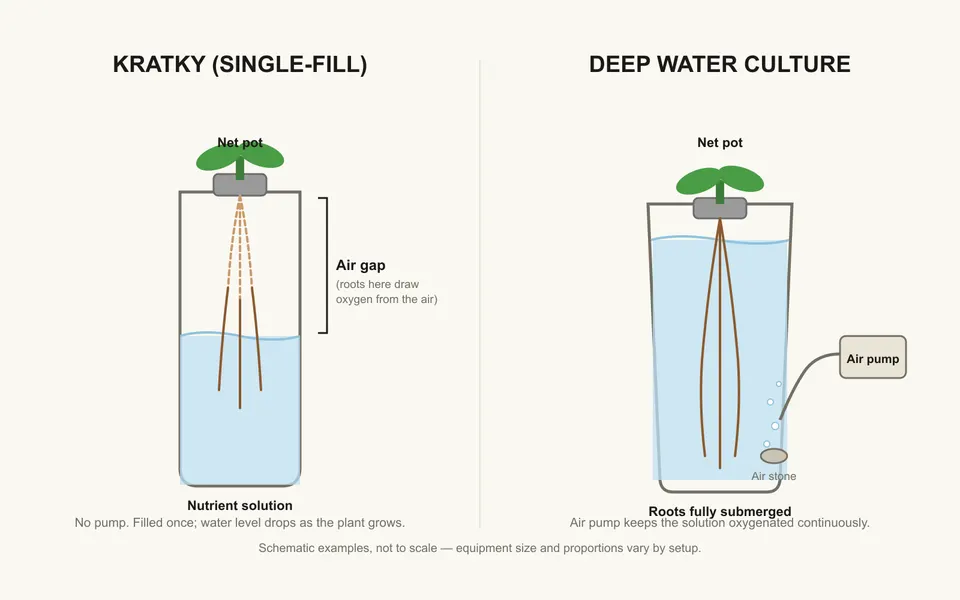
Two different answers to the same problem
Both Kratky and deep water culture (DWC) are water-culture hydroponic systems — the plant’s roots sit in a nutrient solution rather than a solid growing medium. Where they differ is in how they get oxygen to those roots: a submerged root needs it, and still water doesn’t reliably supply enough on its own.
This comparison covers the original single-fill Kratky design and conventional, actively aerated DWC — not every possible variant of either. Documented variations exist on both sides, some of which are noted below rather than treated as identical to the setups being compared.
How Kratky works
Kratky is a non-circulating method, first published by Bernard Kratky (University of Hawaii) in 2009: fill a container with nutrient solution once, suspend the plant above it in a net pot with an inert medium, and let the plant draw the solution down over the growing cycle — no pump, no electricity.
The original paper describes the mechanism directly: as the plant consumes the solution, the water level drops, and a moist air space opens up above it. Roots that end up in that gap draw oxygen from the air rather than the water, while the rest of the root system keeps drawing from what’s left of the solution below. A University of Florida Extension guide implementing this method for lettuce found the entire crop could be grown from one initial fill, with no topping-up needed — though pH strips are still listed as part of the standard kit, suggesting an occasional check remains part of the method’s normal toolkit even when it’s rarely used.
It’s worth being precise about what “non-circulating” actually means here: it describes the original single-fill method, not a rule that a Kratky-style setup can never be touched. Kratky’s own paper describes a third variant where the tank is deliberately refilled with water before harvest, as a controlled step for a specific documented reason (making the floating rafts easier to move) — a managed variant of the same underlying idea, not a workaround. What the basic single-fill method is sensitive to is refilling indiscriminately mid-cycle, since that can disturb the air gap the roots in that zone have adapted to draw oxygen from — not that any and every addition of water necessarily ruins the setup, but that refilling without understanding what it does to the gap is a real risk in the original design specifically.
How deep water culture works
Conventional DWC keeps the roots in continuous contact with the nutrient solution, and because there’s no air gap doing the oxygen work, the solution itself has to be actively kept oxygenated — an air pump and air stone (or, in some setups, a venturi that injects air as the solution circulates) run for as long as the system is in use. That’s the core structural difference from Kratky: DWC’s oxygen supply depends on equipment running continuously, not on a passive gap forming over time.
DWC isn’t one fixed design, either. A hobby setup documented by Oregon State University Extension is a reservoir with net pots or a floating platform and an air pump — closer in scale to a Kratky bucket. A commercial-scale system documented by Virginia Tech Extension is a lined pond with floating polystyrene rafts and submersible or centrifugal pumps circulating solution through it. Both are genuinely DWC; the equipment, scale, and — by extension — the exact maintenance routine differ substantially between them, so there isn’t one single DWC maintenance schedule that applies across every setup.
What does generally apply: because the system runs continuously and doesn’t self-manage the way Kratky’s air gap does, DWC asks for attention that varies by design — covering the water surface to limit evaporation and keep light off it (which encourages algae), keeping the reservoir topped up as the plant draws it down and water evaporates, and periodically checking pH and nutrient strength. Exactly how often depends on the specific setup, the crop, and conditions — a commercial pond-system guide recommends checking two to three times a week, but that’s a commercial-scale figure, not necessarily what a single hobby bucket needs.
The trade-off, without declaring a winner
What these two designs actually trade against each other:
- The original single-fill Kratky method needs no electricity and, once set up, doesn’t require topping up — but that simplicity depends on leaving the air gap undisturbed, and managed variants that do refill deliberately exist as documented departures from the basic method, not its default form.
- Conventional DWC can be actively adjusted throughout the grow — solution topped up, nutrients corrected, equipment checked — but that flexibility depends on the aeration equipment actually running, and on keeping up with whatever checking routine the specific setup and crop call for.
Which suits a given reader better depends on how much they want to actively manage versus set up once, and on matching the crop and growing window to what’s actually documented as workable — not on one method being inherently better, faster, or cheaper. Neither of my sources supports a claim that one method definitively handles a wider range of crops than the other. The research behind this comparison documented a specific crop for Kratky — lettuce, in both Kratky’s own paper and a University of Florida Extension implementation — but didn’t turn up an equivalent crop-specific example for DWC. That’s an absence in what this particular research found, not evidence that DWC hasn’t been used for lettuce or anything else — it simply wasn’t established here.
At a glance
| Original single-fill Kratky | Conventional DWC | |
|---|---|---|
| How oxygen reaches roots | Passively — an air gap forms as the solution level drops, exposing part of the root system to air directly | Actively — an air pump and air stone (or venturi) keep the submerged solution oxygenated continuously |
| Typical equipment | A container (jar, bucket, or similar), net pot, inert growing medium | Reservoir or tank, net pots or floating raft, air pump, air stone, tubing |
| Electricity dependence | None, in the original single-fill form | Continuous — aeration equipment needs to keep running |
| Reservoir/nutrient management | One initial fill; the basic method isn’t topped up mid-cycle (managed variants exist that refill deliberately, for a specific documented reason) | Solution level drops with plant use and evaporation and needs topping up; checking routine varies by setup, crop and conditions |
| Space and light | Depends on the container size and the crop, not the method itself | Depends on the reservoir/raft size and the crop, not the method itself — light needs come from what’s being grown and where, in both cases |
| What a beginner needs to monitor | Mainly the initial setup — solution mix, container fill level at the start; ongoing checks vary but are typically infrequent in the basic form | Aeration equipment actually running, reservoir level, periodic pH/nutrient checks that vary by setup — keeping light off the solution surface |
Light requirements in particular are worth being clear about: how much light a plant needs comes from the crop being grown and where the setup sits, not from whether the system is Kratky or DWC. Neither method changes a plant’s light needs.
This comparison is based on the cited research below, not on No Garden Required actually building or running either system.
Where this fits
This is a comparison, not a build guide for either system yet. A companion piece covering what hydroponics is and whether it suits a small UK space is part of the same collection. A look at which specific crops are realistically worth starting with, in either system, is also part of it.
Sources and further reading
“Set It and Forget It” Hydroponic Lettuce — University of Florida IFAS Extension (HS1488)
Hydro Hints: Deep Water Culture — Oregon State University Extension
Hydroponic Production of Edible Crops: Deep Water Culture (DWC) Systems — Virginia Tech Extension
Just getting started? A straight, checked PDF guide for your space is coming — see what’s coming.
Related articles
Cut-and-Come-Again Salad: What to Actually Expect
It's genuinely one of the best first crops for a small space — but the regrowth slows with each cut, and nobody mentions that part.
26 Apr 2026
First Crops to Grow Hydroponically: A Beginner's Guide
A short, source-backed shortlist — not a long one borrowed from commercial sites. What's directly documented, what's a general recommendation, and what's still genuinely unresolved.
20 Sept 2026
Full Sun vs Partial Shade: What It Costs a Tomato Plant
Tomatoes don't just grow slower in partial shade — the whole plant's behaviour changes, and it's usually fixable-ish, not fatal.
27 Apr 2026