
First Crops to Grow Hydroponically: A Beginner's Guide
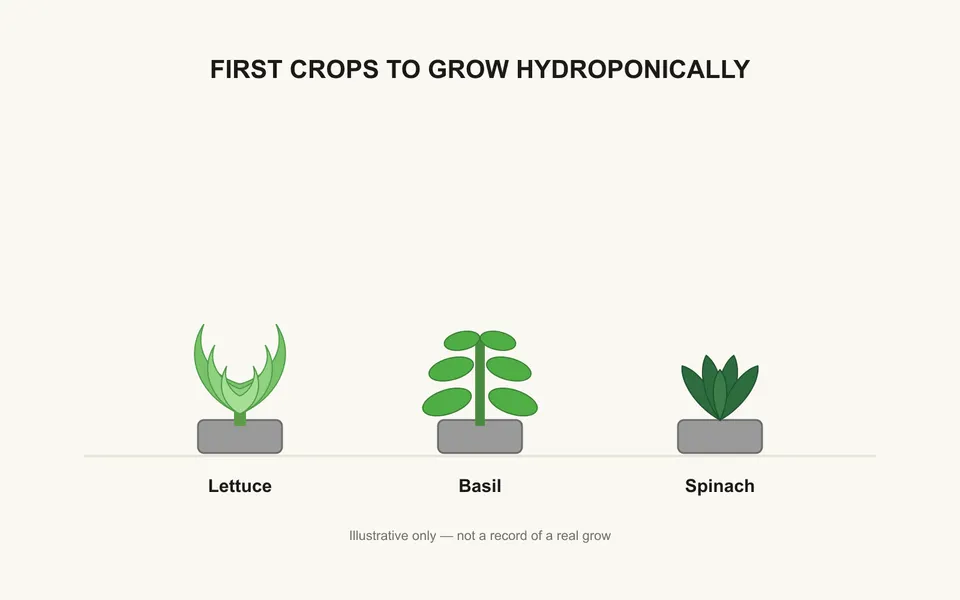
Start with what’s actually documented, not what sounds appealing
It’s tempting to pick a first hydroponic crop based on what you’d most like to eat rather than what’s realistically documented as working for a beginner. This guide sticks to a short list backed by real sources, presenting each one honestly by how much evidence actually supports it — rather than treating every entry as equally proven.
The shortlist
| Crop | Directly documented growing examples | General extension recommendation | Practical considerations from other sources | Questions this research hasn’t resolved |
|---|---|---|---|---|
| Lettuce | Kratky’s own 2009 paper; a full Kratky implementation cycle documented by UF/IFAS Extension; a separate Kratky lettuce implementation documented by the University of California Agriculture and Natural Resources (UC ANR) | Named directly in a UF/IFAS Extension Kratky crop list | RHS confirms the general nutrient-solution requirement that applies to any hydroponic crop, lettuce included | UF/IFAS’s documented harvest timing (3–4 weeks) is specific to Florida’s cool season — I haven’t found a UK-specific source to say how that timing would differ here |
| Basil | A Kratky basil implementation documented by UC ANR | Named directly in the same UF/IFAS extension list | Same general nutrient-solution requirement applies | No institutional DWC-specific documentation found for basil — that’s an absence in what this research covered, not evidence the method doesn’t work for it |
| Spinach | None found specific to spinach (Spinacia oleracea) — a Kratky study on “water spinach” exists, but that’s a different plant and isn’t used here as evidence | Named in the same UF/IFAS extension list | Same general nutrient-solution requirement applies | The weakest-evidenced of the three — its inclusion rests on one general list, not a documented implementation. Worth treating as more tentative than lettuce or basil until better evidence turns up |
Lettuce is the most directly documented option among the crops reviewed for this article. That does not establish that it is universally the easiest hydroponic crop.
What this list doesn’t tell you
The absence of a crop-specific DWC source for any of these three doesn’t mean DWC has never been used for them — it means this particular research didn’t turn up a documented example. Likewise, nothing here rules out other crops (kale and mint both appear in the same UF/IFAS list, for instance) — the shortlist above reflects what’s been verified for this article specifically, not an exhaustive survey.
The UF/IFAS source is explicit that tomatoes, peppers, and cucumbers are possible in a Kratky-style setup but need larger containers and more careful nutrient management — not recommended as a realistic first attempt.
A note on the systems, revisited
The classic single-fill Kratky method relies on an initial reservoir and a developing air gap, as covered in more detail in this collection’s system comparison — it isn’t accurate to call it universally “set-and-leave,” since actual monitoring needs still depend on the specific setup, container size, and crop. Conventional DWC works differently, keeping the solution actively aerated throughout — this piece doesn’t make comparative claims about which system grows a given crop better, since the sourcing for that comparison, crop by crop, doesn’t exist in what this research reviewed.
What you actually need to decide before investigating further
This article helps narrow down a realistic first project to look into — it isn’t sufficient instruction to start growing on its own. Deciding what’s actually right for you means weighing:
- Crop — from the shortlist above, understanding that lettuce and basil currently have stronger documented backing than spinach.
- System — a companion piece comparing Kratky and conventional DWC in more detail is part of this same collection.
- Available light — how much natural light your intended space actually gets, which this guide can’t assess for you.
- Physical space — how much room a setup would realistically take, which varies by system and container choice, not by the crop alone.
- Access to suitable nutrients — a hydroponic-specific nutrient product, mixed according to that specific product’s instructions rather than assumed to be interchangeable with another. Different products aren’t guaranteed to share the same mixing ratios or nutrient composition, even though the general requirement — a balanced major-nutrient and trace-element mix, per the RHS — applies across all of them.
- Access to practical setup guidance — this guide doesn’t provide that; see below.
What this guide is, and isn’t
This is a starting-point shortlist, not a step-by-step build tutorial, and it is one part of a collection about understanding and choosing — not a complete start-to-harvest course. No Garden Required has not grown any of these crops hydroponically or tested any specific equipment; every claim here is attributed to the source that made it, not to firsthand experience.
Where this fits
A companion piece explaining what hydroponics is and whether it suits a small UK space, and a second comparing Kratky and deep water culture in more detail, are both part of this same collection.
Sources and further reading
“Set It and Forget It” Hydroponic Lettuce — University of Florida IFAS Extension (HS1488)
Just getting started? A straight, checked PDF guide for your space is coming — see what’s coming.
Related articles
Cut-and-Come-Again Salad: What to Actually Expect
It's genuinely one of the best first crops for a small space — but the regrowth slows with each cut, and nobody mentions that part.
26 Apr 2026
Full Sun vs Partial Shade: What It Costs a Tomato Plant
Tomatoes don't just grow slower in partial shade — the whole plant's behaviour changes, and it's usually fixable-ish, not fatal.
27 Apr 2026
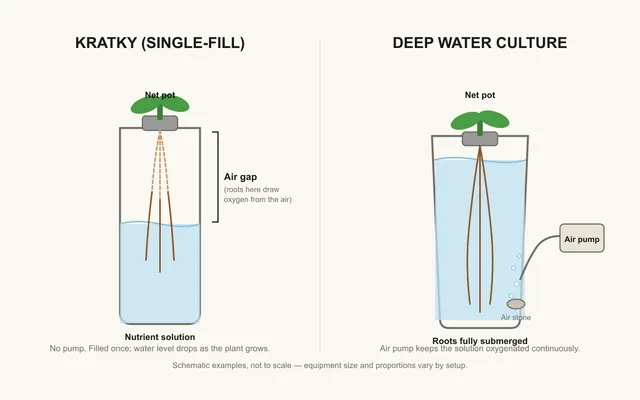
Kratky vs Deep Water Culture: A Beginner's Comparison
The classic single-fill Kratky design and a conventional, actively aerated DWC setup solve the same oxygen problem differently — how each actually works, and what the trade-off means, without declaring one universally better.
20 Sept 2026