A Productive 2m² Balcony Layout
What this is, and isn’t
A worked layout, not a documented trial — real crops and real container choices, combined into one plan for a small balcony, drawing on the sizing and safety guidance already checked elsewhere on this site. It’s a suggested starting point, not a claim that this exact layout has been built and measured as one project.
Built for roughly 2m² of usable balcony floor — small enough that every container earns its place, and every decision (floor, railing, or vertical) has to be deliberate rather than assumed.
The one thing this plan can’t tell you
Your balcony’s actual weight allowance depends on your specific building — this plan doesn’t, and can’t, state a universal safe limit. Wet compost is heavy (a large container can weigh 20-30kg+ once watered), and UK leases and building regulations do specify limits, often concentrated near the edges rather than spread evenly. Check with your building management, lease documentation, or a structural professional before filling a balcony with several large containers. This layout deliberately leans on smaller, lighter containers partly because of that uncertainty, not despite it.
The layout
The five elements
| # | Element | What & where | Why here |
|---|---|---|---|
| 1 | Bush tomato (floor) | Large container, back wall, sunniest spot | Needs the most floor space and the most sun; kept off the railing entirely — a fruiting, top-heavy plant is a poor railing candidate |
| 2 | Salad trough (floor) | Small/shallow container, opposite corner | Tolerates the slightly less sunny corner better than a fruiting crop would |
| 3 & 4 | Railing planters | Herbs, and a trailing crop like strawberries | Straddle-style (hooking over the rail with weight resting inward), not fully outward-hanging — see balcony railing planters: are they actually safe? for why that distinction matters and what to check before hanging anything |
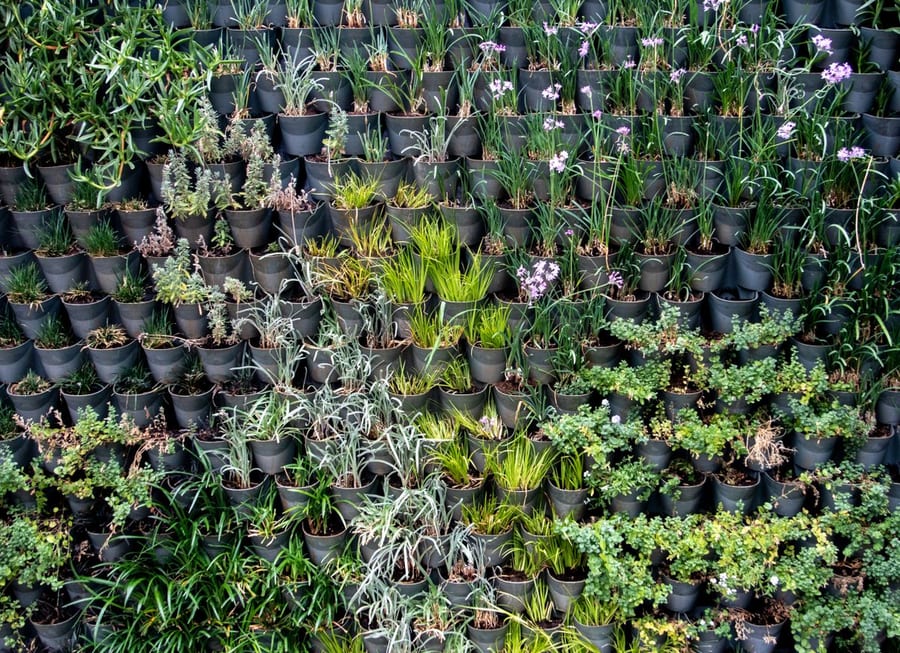
| 5 | Vertical planter | Fixed to a side wall, out of the floor footprint entirely | Genuinely useful for shallow-rooted, compact crops specifically, since floor space is the actual constraint here — heavier or deep-rooted crops don’t suit a vertical pocket regardless of how tight floor space is |
Container sizes
- Bush tomato: Large — 35cm+ pot or fabric grow bag. Plastic or fabric over terracotta specifically for weight and moisture retention — see best containers for tomatoes.
- Salad trough: Small — a shallow trough under 20cm deep is genuinely enough; salad doesn’t need root depth.
- Railing planters: Deliberately smaller and lighter than the equivalent floor container for the same crop — a lighter, straddle-style trough, not a full-depth pot hung off the rail.
- Vertical pockets: Small individual pockets, one shallow-rooted crop per pocket (herbs, salad, strawberries) rather than anything wanting real depth.
Sowing and planting schedule
| Element | Sow/plant | Notes |
|---|---|---|
| Bush tomato | February-April indoors | Plant out after last frost |
| Salad trough | March-September | Resow every 2-3 weeks |
| Railing herbs (e.g. chives) | March-June | Perennial — cut repeatedly rather than one harvest |
| Railing strawberries | Plant runners/young plants spring, or pot-grown any time in the growing season | Not a from-seed crop in year one |
| Vertical pockets | Match to whatever’s planted — salad March-September, herbs March-June | Stagger pockets so they don’t all need resowing at once |
Check the UK Sowing Calendar for exact windows.
Wind, weight and water — the three real balcony constraints
An elevated balcony sits in meaningfully stronger, more constant wind than ground level, which dries containers faster and stresses tall plants (the tomato in particular will likely need staking earlier and more securely than the same variety on a sheltered patio). Weight is addressed above. Watering needs checking more often than a patio equivalent, especially for the smaller railing and vertical containers, which dry out faster relative to their size — check compost moisture directly rather than a fixed schedule, per how much water container vegetables actually need.
What this costs
Not put a number on this, for the same reason as any other plan on this site: pot, railing-bracket and compost prices vary by material, size and retailer. What’s worth pricing specifically for a balcony layout: straddle-style railing brackets/troughs (a real, distinct product category, not the same as a floor pot) and a vertical planter system, alongside the usual pot and compost costs.
What to actually expect from the harvest
Kept deliberately cautious: this specific five-element combination hasn’t been built and measured as one project. Salad and herbs from small containers give real, repeated but modest harvests; tomato yield in a large container depends heavily on variety, sun hours actually received, and consistent care.
Adapting for a shadier balcony
Swap the tomato for a shade-tolerant crop if the balcony gets under 4 hours of direct sun — see north-facing balcony? here’s what will actually grow for a realistic shortlist (mixed salad, spinach, kale, mint, chives all cope with partial shade genuinely well). Herbs on the railing should shift toward chives and mint over basil in a shadier spot, since basil specifically needs strong direct light.
Frost and season caveats
Tomato and strawberries (if grown from young plants rather than dormant runners) are frost-tender — hold off planting out until after your local last-frost date. Salad and hardy herbs like chives tolerate an earlier, more cautious start.
Just getting started? A straight, checked PDF guide for your space is coming — see what’s coming.
Related articles
The Best Vegetables for a First Patio Container Garden
A patio's extra floor space and shelter from wind open up crops that struggle on a balcony — here's what's actually worth using that room for in your first season.
23 May 2026
A Six-Container Patio Planting Plan
Six containers, six crops, one realistic first-season patio plan — real container sizes, real sowing dates, and no invented costs or yields.
17 Sept 2026
A Year of Harvests From a Small Container Collection
Four containers, rotated through the seasons instead of left empty half the year — a worked succession plan using real UK sowing windows.
17 Sept 2026