Do Flowers Actually Help Your Vegetable Garden?
Why I stopped treating flowers as decoration
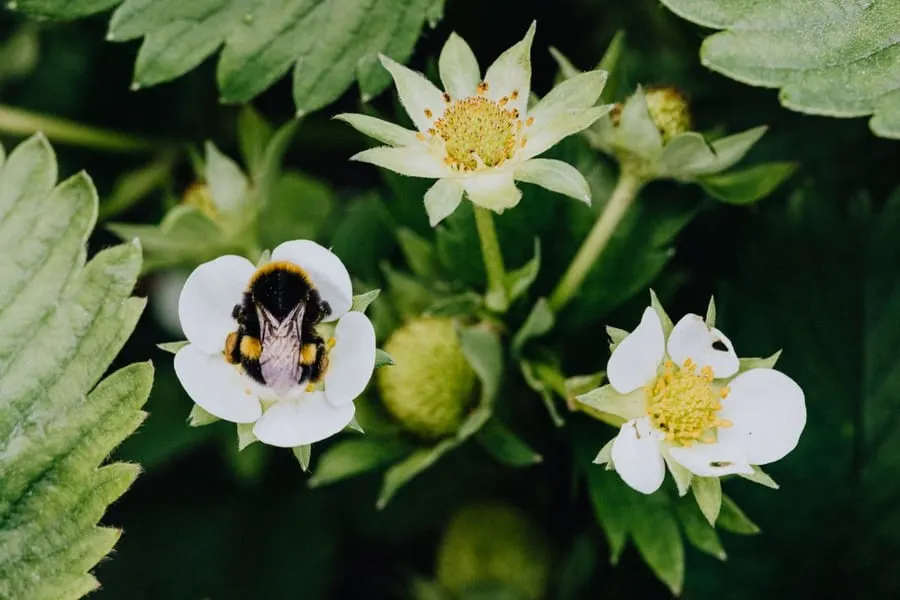
I’d filed flowers-among-the-vegetables as a nice-to-have rather than something that actually changes what you harvest, until I started working borage and calendula into my own beds and noticed the difference in fruit set myself. For anything that needs a flower fertilised to produce food — tomatoes, chillies, beans, courgette, strawberries — more pollinator activity isn’t cosmetic, it’s a direct input to yield.
Where this matters most
Courgette is the clearest example: it carries separate male and female flowers, each open for only a single day, and without a pollinator visiting in that window a female flower simply drops unfertilised. Tomatoes and chillies are self-fertile but still rely on wind or an insect disturbing the flower to actually move pollen inside it — a spot with little airflow and few visiting insects genuinely produces less fruit, not just slower fruit. Strawberries need real pollinator visits more than either of those to set fruit well.
A garden or bed with a few flowering plants worked in gets more pollinator visits than one growing vegetables alone, which directly reduces how often a fruiting crop under-sets from poor pollination.
What’s worth planting
Several of the strongest options are on the RHS’s own evidence-based Plants for Pollinators list, not just commonly recommended:
Borage is a particularly easy, high-value choice — it flowers for months, self-seeds readily so you’re unlikely to need to buy it twice, and its flowers are edible. Phacelia is one of the most attractive plants to bees of anything commonly grown, and it doubles as a green manure — let it cover a bare patch and dig it in before it sets seed, and it’s improving the soil as well as feeding pollinators. Calendula (pot marigold) is compact, easy from seed, and flowers for most of the season. Nasturtium is easy from seed too, and is specifically well-evidenced as a companion for squash-family crops and brassicas, not just generally pollinator-friendly.
Alyssum is worth a specific mention for a different reason: alongside drawing pollinators, it also draws hoverflies, whose larvae are significant predators of aphids — so it’s doing pest control and pollination at the same time, in the same way the strongest companion-planting pairings tend to work on more than one front.
You don’t need a dedicated flower bed
None of these need their own space carved out. A few plants worked into the gaps between vegetables — the edge of a bed, the corner of a container arrangement — is enough to make a real difference to pollinator visits, and several of them (borage, calendula, nasturtium) are genuinely low-maintenance once established.
A boost, not a fix on its own
This isn’t a claim that flowers will fix a badly under-pollinated crop on their own — for courgette specifically, hand-pollination is still worth knowing as a direct fix when fruit isn’t setting. But growing a few evidenced pollinator plants is the upstream version of the same fix: more visits happening on their own means less hand-pollination needed in the first place, for very little space or effort spent.
Sources
Companion planting with French marigolds protects tomato plants from glasshouse whiteflies
Just getting started? A straight, checked PDF guide for your space is coming — see what’s coming.
Related articles
Do Companion Plants Actually Deter Pests on a Small Balcony?
The evidence is real for some specific pairings and genuinely thin for others — companion planting isn't one claim, it's dozens of different ones.
25 Apr 2026
Does Copper Tape Actually Stop Slugs?
Lab tests say copper barriers can work. The RHS's own real-garden trial found no measurable reduction in damage. Here's why both can be true.
22 Mar 2026